
Localização:
Sala 12.2.21 DCSPTData de início:
Seminário de Investigação GOVCOPP - Janeiro
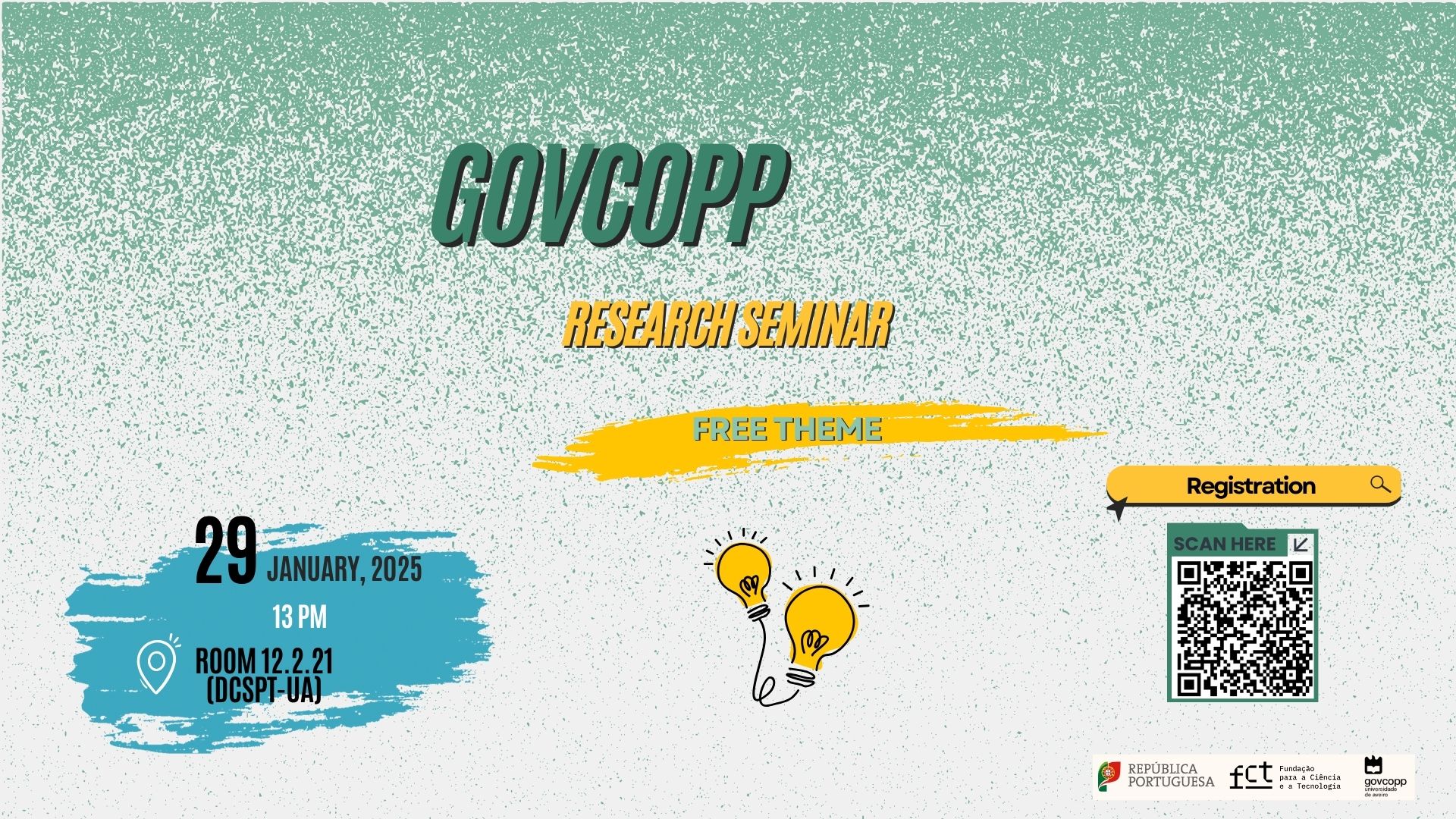
O primeiro Seminário de Investigação GOVCOPP de 2025 terá lugar no dia 29 de janeiro. Junte-se a nós entre as 13h00 e as 15h00 para uma sessão enriquecedora que reunirá apresentações dos quatro grupos de investigação da nossa unidade de investigação.
Tema Livre
29 Janeiro 2025
Sala 12.2.21 (DCSPT)
13h - 15h
Grupo de Investigação CIS
Evolution and Challenges of Sustainability Reporting in the Banking Sector: A Systematic Literature Review

Resumo
The objective of this study is to present an overview of sustainability reporting in the financial industry between 2016 and 2024, carrying out a systematic review of the literature on the topic in the banking sector. The theoretical framework addresses the integration of sustainability from the perspectives of stakeholders, agency and legitimacy theories, highlighting the interrelationship between financial practices and social responsibility. The research used quantitative and qualitative methods, focusing on a systematic review of the literature, analyzing databases such as Scopus and Web of Science in 116 articles. The results showed an annual publication growth rate of 29.68%, with an emphasis on environmental and social sustainability practices. The dissemination of knowledge about sustainability in the banking sector remains low. The central themes included sustainability disclosure, circular economy and FinTechs. Limitations in regulations and the lack of adequate regulations in developing countries, especially in Latin America and Africa, make it difficult to effectively implement these practices, highlighting the need for greater supervision and awareness. This study highlights that the sustainability disclosure in the banking context is a topic that still lacks sufficient exploration.
Grupo de Investigação PI2
Integrating Environmental Monitoring Tools in Portuguese Municipalities: A Study on Strategic Environmental Assessment and Spatial Planning Reports

Resumo
The role of Strategic Environmental Assessments (SEAs) in urban planning is becoming increasingly significant, as these tools are essential for promoting sustainability in cities, which are increasingly vulnerable to the impacts of climate change. Nevertheless, the practice of monitoring SEAs remains underdeveloped in numerous contexts. Research that integrates various monitoring instruments across territorial and environmental management is limited, with most studies focusing on the monitoring of individual SEAs or isolated plans. This article aims to describe and evaluate the monitoring processes for SEAs within Municipal Master Plans (MMPs) and Environmental Impact Assessment Reports (RSSPs), examining the potential interrelationships between these instruments. Through a comparative analysis of 12 Portuguese municipalities, the study reveals that monitoring frequency is low, particularly for SEAs, where the practice is almost non-existent. The findings indicate that the monitoring programs outlined in SEA Environmental Declarations directly influence the development of RSSPs, highlighting opportunities to improve integration across environmental management tools. Additionally, this study emphasizes the need for further empirical research to deepen the understanding of challenges in monitoring SEAs within MMP frameworks.
Grupo de Investigação SDS
Management Accounting in Portuguese Municipalities: adoption and disclosure
Resumo
The Accounting Standardization System for Public Administrations establishes the mandatory implementation of management accounting in Portuguese municipalities, foreseeing the disclosure of the respective information in the rendering of accounts. In this context, the main objectives of this research are to study the implementation of the Public Accounting Standard (NCP) 27 in Portuguese municipalities, concerning the adoption of a management accounting system and the disclosure of the respective information in the rendering of accounts. To achieve these objectives, data was collected through a questionnaire. The results show that 66,3% of the surveyed municipalities have already started implementing NCP 27. Regarding the disclosure of management accounting information as stipulated in points 34 and 37 of NCP 27, most surveyed municipalities only disclose costs, failing to comply with the requirement to disclose information on income and results.
Grupo de Investigação TD
Traditional saltpans and tourism: is it an opportunity?

Resumo
Traditional saltpans possess significant natural and cultural heritage values that significantly contribute to a region’s distinctive landscape, lending them a competitive advantage as a tourism destination. These multifunctional areas combine artisanal salt production with tourism activities. Despite the threat of disappearance, these saltpans persist as emblematic representations of some destinations. However, there is a lack of studies analysing the duality between the risk of disappearance and emerging market trends, supporting the identification and formulation of integrated sustainable strategies for preserving these invaluable assets. To bridge this research gap, a comparative case-study analysis was carried out in two coastal regions characterized by active traditional saltpans with different development conditions: Aveiro, Portugal, and Guérande, France. The selection of case studies was based on information collected in prior research projects and scientific studies examining various models of saltpan development. Data were collected from secondary sources such as existing policy documents, reports and scientific publications to conduct documental analysis for each of the case studies. Secondly, a comparative analysis was undertaken to identify and explore the best practices in the Guérande saltpans and evaluate how they could serve as guidelines for the Aveiro saltpans.
Thus, an answer is provided for the research question discussed within this study on whether traditional saltpans could subsist of market-driven initiatives exclusively focused on tourism purposes. This study presents a set of guidelines for the formulation of sustainable strategies that utilize tourism as an essential tool in the preservation of saltscapes and salt heritage. The findings and insights are considered useful to researchers, policymakers and stakeholders. It approaches the duality between the threats to saltpans (e.g. environmental pollution, weak governance and tourism pressures) and the opportunities they present, by adopting a participatory and inclusive multi-stakeholder approach to overcome these threats. From a managerial perspective, this study delivers key lessons on how to take advantage of market opportunities in empowering local communities such as salt workers and tour guides and enabling them to provide authentic experiences for visitors in the context of natural and cultural heritage. The findings, along with the proposed guidelines, have practical implications for other traditional saltpans.
