Localização:
Sala 12.2.21 DCSPTData de início:
Seminário de Investigação GOVCOPP: Paz, Justiça e Instituições Fortes
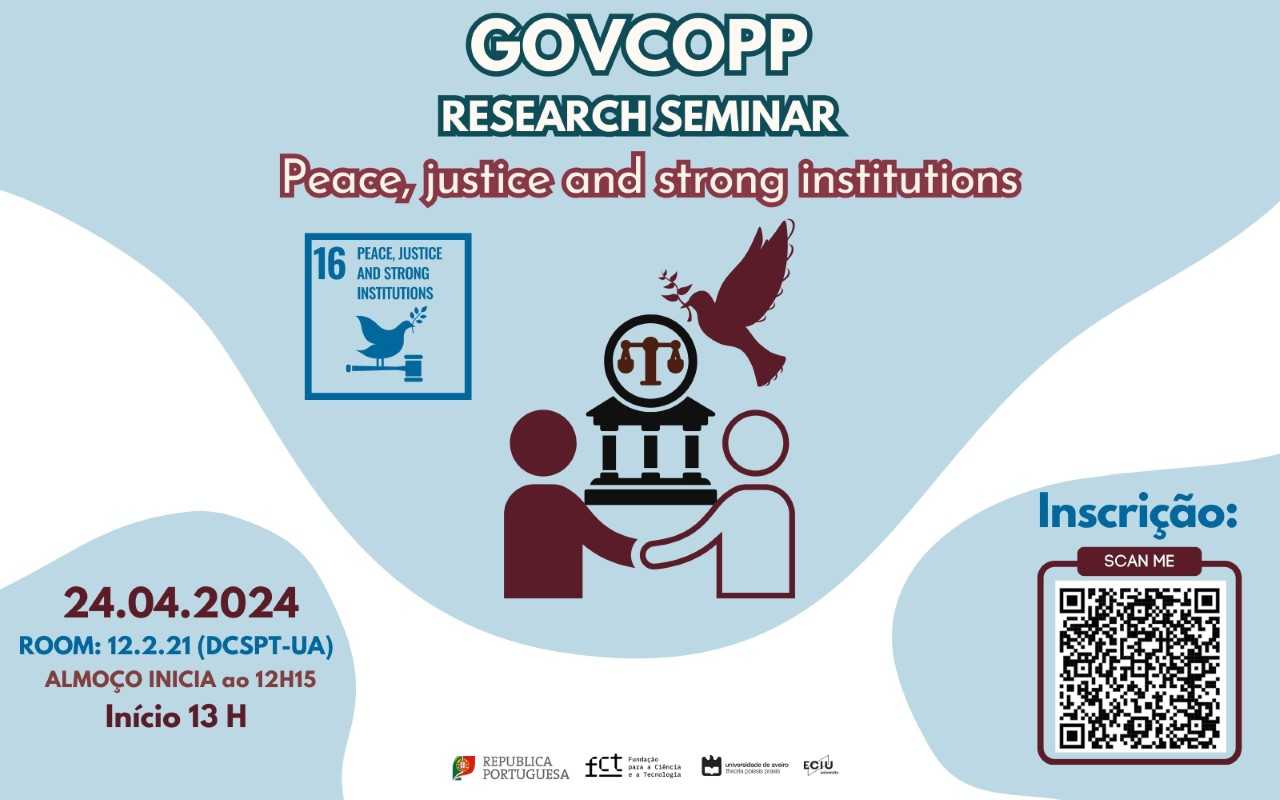
O próximo Seminário GOVCOPP terá lugar no dia 24 de abril (13h - 15h). Convidamo-lo a juntar-se a nós numa sessão que irá revelar projectos de investigação interessantes e suscitar um debate estimulante sobre três questões (e objectivos) inter-relacionados que constituem a espinha dorsal de uma sociedade humana próspera.
Paz, Justiça e Instituições Fortes
24 Abril 2024
Sala 12.2.21 (DCSPT - UA)
13h - 15h
TD Research Group
The role of a Portuguese social tourism organisation in creating travel opportunities for seniors


Abstract
Although leisure and holidays has been considered a human right, many people are still excluded from engaging in tourism trips for several reasons. Notwithstanding the range of benefits of tourism for seniors, many factors, including health and economic constraints, inhibit elderlies to participate in tourism trips. Some organisations devote themselves to social tourism, attempting to make tourism accessible to all, reducing inequalities and decreasing the exclusion of people with few resources, with disabilities or other constraints. This is the case of the INATEL foundation, a Portuguese organisation that has developed various social tourism programs that offer travelling opportunities for seniors. The aim of this presentation is to highlight the importance of this organisation, identifying some of the programs it created. Moreover, several socioeconomic benefits of some of these programs for seniors will be revealed, in diverse domains. The role of this organization for more inclusive tourism will thus be analysed, showing its role for a more sustainable tourism development in the country.
PI2 Research Group
Streaming city councils’ meetings on social media before, during and after the pandemic

Abstract
The main objectives of this article are to understand the extent to which the COVID-19 pandemic affected the streaming of city council meetings on social media networks and whether, having this effect existed, it has persisted over time. A complementary objective is to find if there are particular characteristics of municipalities that favor the streaming of city council meetings on social media networks. To the best of the author’s knowledge, this is the first study to address these objectives. To achieve them, data were collected and analyzed from all 308 Portuguese municipalities. These included the registration of 4905 streams published on Facebook and YouTube, corresponding to 2639 city council meetings from 74 municipalities, held between January 1, 2019, and December 31, 2022. The main findings are: the number of Portuguese municipalities that streamed their city councils in each month more than doubled during the acute phase of the pandemic; this effect started to fade immediately after the easing of the pandemic; and it started to grow again immediately after the September 2022 municipal elections. The main theoretical implication is that disruptive events such as sanitarian crises and local elections can trigger the adoption of innovative forms of the use of social media networks by municipalities, namely those related to transparency, such as streaming city councils. The study also contributes to confirm population size, voter turnout, and margin of victory as relevant determinants of online transparency at the local level.
CIS Research Group
The impact of digital platforms on entrepreneurship: Unveiling trends and challenges amidst the gig economy

Abstract
The rise of digital platforms has driven the emergence of diverse business models relying on the gig economy (GE) as their foundation. These models entail peer mediation within short-term contracts, consistently intertwined with the platform economy, and intersecting with other economic frameworks such as the sharing economy, collaborative economy, and circular economy. In literature, authors have been analysing the impact of digital platforms on entrepreneurial activity from two main perspectives: (1) the interests of platforms by promoting an independence appeal to conceal their intention of responsibility exemption/market hegemonies, resulting in challenges for micro-entrepreneurship; or (2) empowerment of worker autonomy and providing resources that contribute to their entrepreneurial knowledge, experience, and well-being. Therefore, employing a focused literature review, bibliometric analysis, and machine learning topic models, we investigate the trajectory of the GE and its influence on entrepreneurial activity. Initial findings reveal a consistent growth trend within the GE and its potential to facilitate individuals' entry into the entrepreneurial landscape. However, empirical evidence on specific contributing factors remains scarce. To address this gap, the research investigates the behavioral and psychological dynamics between GE workers and platforms, aiming to identify solutions supporting nascent entrepreneurs' venture creation. Through an examination of affective, cognitive, and socio-economic variables, we aim to elucidate the mechanisms underlying entrepreneurial intention and orientation within the context of technology-mediated entrepreneurship. Ultimately, our results aim to inform policy and practice, empowering individuals towards entrepreneurship and enhancing societal welfare.
SAD Research Group
How to enact a shapeshifting concept? Territorial cohesion within European and local educational strategies

Abstract
The literature about the conceptual fuzziness of territorial cohesion is broad, despite cohesion being a flagship EU-concept and the ultimate goal of its funding. While relying on the creative framing of the “tofu-like nature (…) of key concepts” (Sorensen & Eeva, 2024, p. 3), we argue that territorial cohesion also acquires different flavours when seasoned with different spices, especially when concerning educational issues.Our study intends to uncover the different varieties of territorial cohesion when linked to education, both at the European and the local (Portuguese) governance levels. Preliminary results point towards a European tendency to further reinforce the shapeshifting nature of territorial cohesion in its connection with education. Yearly European reports often frame this link by mirroring topical matters on the agenda. Local strategies seem to ascribe greater importance to concrete policies pursuing territorial cohesion, but often echo similarly vague mottos. This study addresses other mismatches concerning the fostering of territorial cohesion through the multilevel governance of education. Our research relies on the assumption that uncovering those paradoxes can reveal decision-making challenges usually overlooked. The cognitive and conceptual deconstruction of seemingly universal understandings might thus promote a fruitful place-based enactment, especially at a time when results-oriented approaches to education appear to prevail.
References
Sorensen, T. B., & Eeva, K. (2024). Re-articulating the form of the political: Contemporary education governance in the European Union. Introduction to the Special Issue. European Educational Research Journal. https://doi.org/10.1177/14749041241231021
Registrations to attend the seminar are open until April 23 rd at 5 p.m.
Registrations must be sent by no later than April 22 nd (4.30 p.m.) if you also wish to join in for the lunch that precedes the seminar.
