Location:
Room 12.2.21 DCSPTStart Date:
GOVCOPP Research Seminar - May
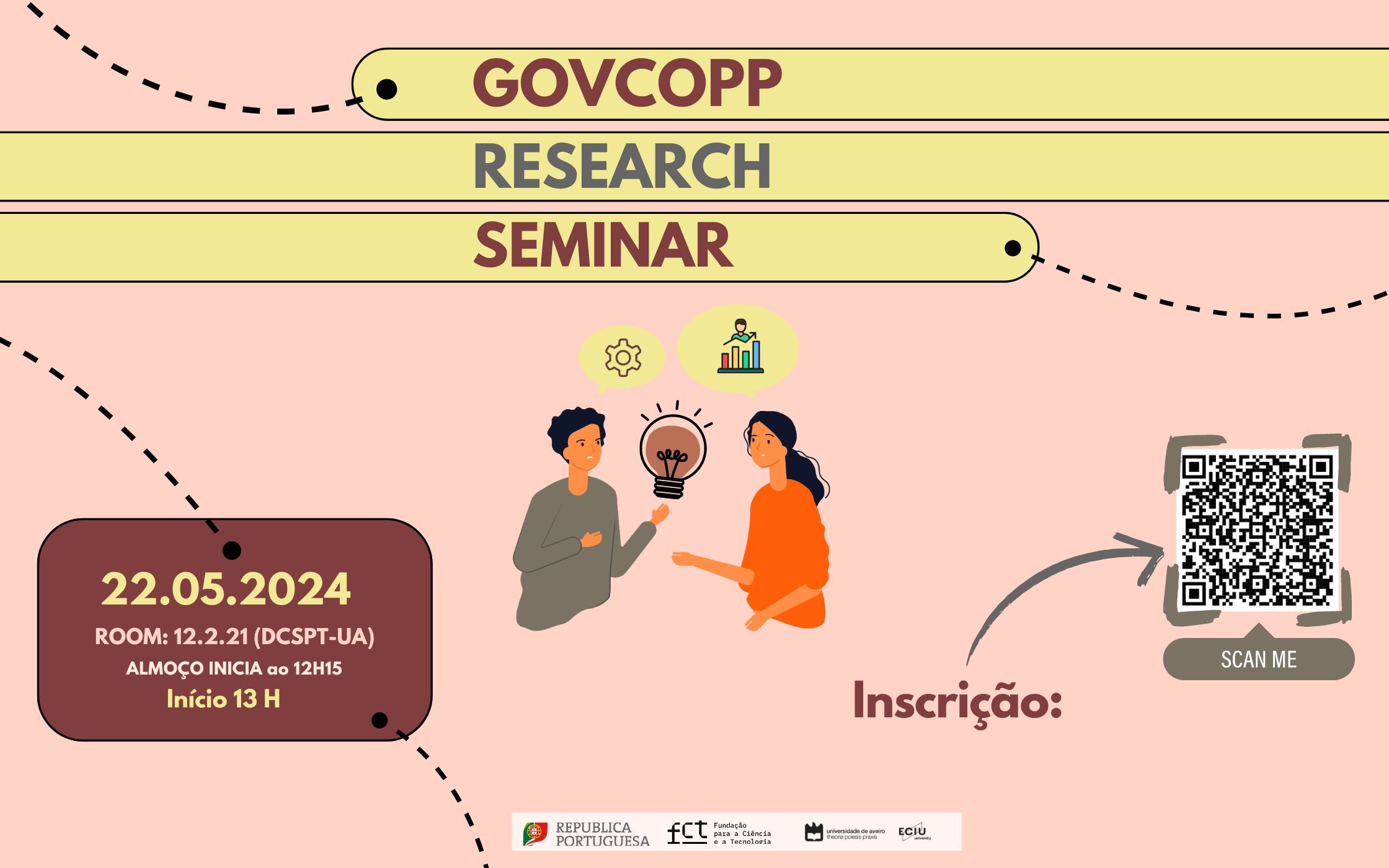
The next GOVCOPP Seminar will take place on 22 May (1pm - 3pm). We invite you to join us for a session that will reveal the diversity of research work carried out by members of our research unit.
No Predefined Theme
22 May 2024
Room 12.2.21 (DCSPT - UA)
1 p.m. - 3 p.m.

Abstract
Tourism is undeniably a very important sector for the world economy. Low-density and coastal areas are poles of development, and attention must be paid to their sustainable growth. Some of these coastal areas are low density/rural. This study aims to analyze the evolution of the main existing models that portray low-density tourism in coastal areas. The methodology used was the literature review analysis on the themes of coastal tourism and low density territories, as well as the analysis of the main models developed for these two areas. The results indicate the need to update the previously proposed models, giving rise to the ‘Low-density tourism model in coastal areas’. It is thus necessary for low-density tourism in coastal areas, the creation of extra income; development of new opportunities; increased demand for endogenous products; creation of new local economies; low agglomeration; and health & wellness.
PI2 Research Group
‘An Ocean in between the waves’: A systematic approach to party transnational ties of the Latin American Radical Left

Abstract
The wave of electoral success of the European Radical Left in 2015 has been regarded as a phenomenon that not only fed on the Latin American (Radical) Left’s experience but appears to have also influenced it in return. Nonetheless, these apparently relevant transatlantic links remain largely under- researched. This study seeks to map these ties, as well as assess their relevance vis-à-vis ties with other parties and (regional) party families as well as their nature. Contrarily to other studies on party transnational relations, we attempt to provide a systematic mapping and analysis of these ties. To achieve this end, we focus on trying to understand how the electoral success of the European Radical Left was reacted to by 4 of its Latin American counterparts. We rely, hence, on the gathering and analysis of social media data (Twitter and Facebook) from 2015 of 4 Latin American Radical Left parties with distinct ideological and organisational profiles. In this presentation, we provide an overview of the interactions and transnational network of the selected parties as well as an early discussion of the findings.
CIS Research Group
Participatory construction of an integrated survey of cultural ecosystem services
Abstract
Cultural ecosystem services include challenges and benefits of coexistence between human beings and Nature. They can create social innovation for communities and preserve regional natural resources, in addition to significantly contributing to reducing the impacts of climate change. The "Integrated Survey of Cultural Ecosystem Services" can support changes and actions in this process. The participation of multiple actors – internal and external – in the survey is essential. However, it is necessary to consider the civic engagement of inhabitants in the collective construction of the parameters they desire for ecosystemic social innovation in their region.
Abstract
The need to evacuate a public area in the event of natural and/or human disasters, with the purpose of ensuring the safety of all the occupants, implies that an evacuation plan is in place. Several alternatives can be studied using computer simulation, thus ascertaining which of these is best for the situation under analysis. Being Simulation a key Industry 4.0 technology for developing exploratory planning and operational models, its contribution to support intelligent decision making is noticeable. We will walk through several practical examples such as the ones of a well-known Football Stadium, a River Cruise Boat, a Hotel, evidencing the critical value of simulation for decision- support!
Registration to attend the seminar is open until 21 May at 5pm
If you would also like to take part in the lunch before the event, you must register by 20 May at 4.30pm
