Location:
Room 12.2.21 DCSPTStart Date:
GOVCOPP Research Seminar - October
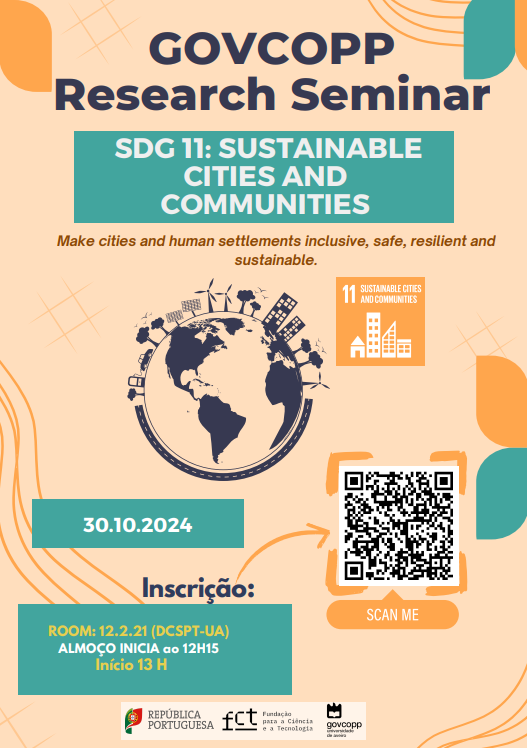
The next GOVCOPP Research Seminar - October 30 th - will be centred on the topic of sustainability and, in particular, the promotion of sustainable cities and communities. Join us between 1 p.m. and 3 p.m. for an enriching session that will bring together four thought-provoking presentations on an issue that plays a central in addressing the future challenges faced by our society (e.g., climate crisis and its implications).
Sustainable Cities and Communities
30 October 2024
Room 12.2.21 (DCSPT)
1 p.m. - 3 p.m.

Abstract
Increasing voter abstention is a pressing concern in several european countries and has triggered global efforts to mitigate this phenomenon. In this context, transparency is a fundamental strategy for restoring citizens' trust and strengthening the bond between them and their government. With the growing adoption of the internet and new technologies by the population, it has become essential to use these digital tools as a means of promoting transparency through the dissemination of information and data. Methodologically, this study constructed an index of the digital maturity of municipalities and an index of municipal transparency, and proceeded with the estimation of an econometric model, which showed that digital transformation has a significant impact on transparency, which consequently increases trust and improves the image of government.
In addition, the study carried out an exploratory geographical analysis of the level of transparency of portuguese municipalities, providing valuable insights into regional disparities. As an additional contribution, it presents policy recommendations aimed at the efficient implementation and continuous monitoring of transparency-oriented technologies. These guidelines are intended to support public managers adopt practices that promote civic participation, fight corruption and strengthen citizens' trust in institutions.
Abstract
The promotion of community resilience is a complex and understudied phenomenon. This article aims to contribute to this literature gap by assessing the role of citizen science (CS) approaches in the development of community resilience since CS is considered a promising approach for generating new knowledge through fostering the participation of citizens (non-professional scientists) in research activities. The results show that CS approaches are relevant for developing resilience abilities through i) the collection of new data from new sources or remote places where data is scarce, allowing for a better characterization of potential hazards, and the identification of community needs, perceptions and behaviours; ii) enhancing community awareness and knowledge about hazard protection; iii) increase human and social capital through specific training initiatives; and iv) promote the cooperation between community (citizens), academia (professional scientists) and government (policymakers), which is relevant for the development of public policies shaped to the local context, and aligned with community’s needs and expectations.

Abstract
This research seeks to assess to what extent the European Structural and Investment Funds (ESIF) have translated into sustainable development at the municipal level. A new methodology for constructing a sustainable development progress index (SDPI) was proposed. The methodology was applied to Portuguese municipalities. The resulted SDPI and European funding of the Portuguese municipalities were analysed using matrix graphs and data envelopment analysis (DEA).
There is no significant correlation between European funding and SDPI between 2014 and 2020. Most of the municipalities that showed the most progress between 2014 and 2020 and were more efficient are considered less developed. European funding allows less developed regions, such as the Center, Alentejo or the Azores, to make significant leaps in sustainable development. When funding is lower, as in the Lisbon Metropolitan Area and the Algarve, progress in terms of sustainable development is hampered.
Policymakers can finally observe the progress of their municipalities, identify their strengths, benchmark municipalities and draw up plans to boost their progress towards Sustainable Development.
Abstract
The discourse on sustainability in tourism research has increasingly aligned with the Sustainable Development Goals (SDGs) agenda, positioning sustainable and responsible tourism at the forefront of scholarly attention. In this context, creative tourism has established itself as an autonomous domain, characterized by its focus on experiential learning, active participation, co-creation, and creative self-expression. Central to creative tourism is its engagement with local communities, offering a responsible alternative to traditional forms of tourism while fostering cultural sustainability. This type of tourism contributes to the territorial development of tourism destinations through a variety of heterogeneous benefits. These benefits are closely tied to the promotion of Sustainable Development Goal 11: Sustainable Cities and Communities, which emphasizes the creation of inclusive, safe, resilient, and sustainable urban spaces. In this context, creative tourism strategies can serve as catalysts for sustainable urban and regional development. They facilitate the preservation and valorisation of both tangible and intangible heritage, support the sustainable management of cultural resources, and promote authentic, meaningful experiences for visitors recognizing the paramount role of local communities. In this intersection, different creative tourism local-based examples are presented with the potential to be implemented in urban settings while contributing to the SDG11.
Registration to attend the seminar is open until the 29 th October at 5 p.m.
If you would also like to take part in the lunch before the event, you must register by the 23 rd October at 4.30pm
